
Phrase English: learning to speak with phrases from TV shows
Why
Adults with a solid base (I'm one of them) read fluently but get lost in conversation: they don't know how to translate a phrase or how to say it naturally. Apps are either expensive or teach single words, and they don't notice when someone makes the same mistake over and over.
Hypothesis: if you try to say a phrase, compare it with the original, use it in a dialogue and then review it on a schedule, it stays in your active vocabulary.
How I'll know it works: the share of phrases recalled at the 7-day review (target 60%+), D7 retention (target 25%+) and lesson time of no more than 4 minutes per phrase.
The starting point
There was an idea and a quick 7-screen Figma prototype: just a lesson, no product around it. I took apart what didn't add up, looked at how lessons work in competing apps and in textbooks (what they teach first, how often they review), and wrote down good practices that I later checked against.
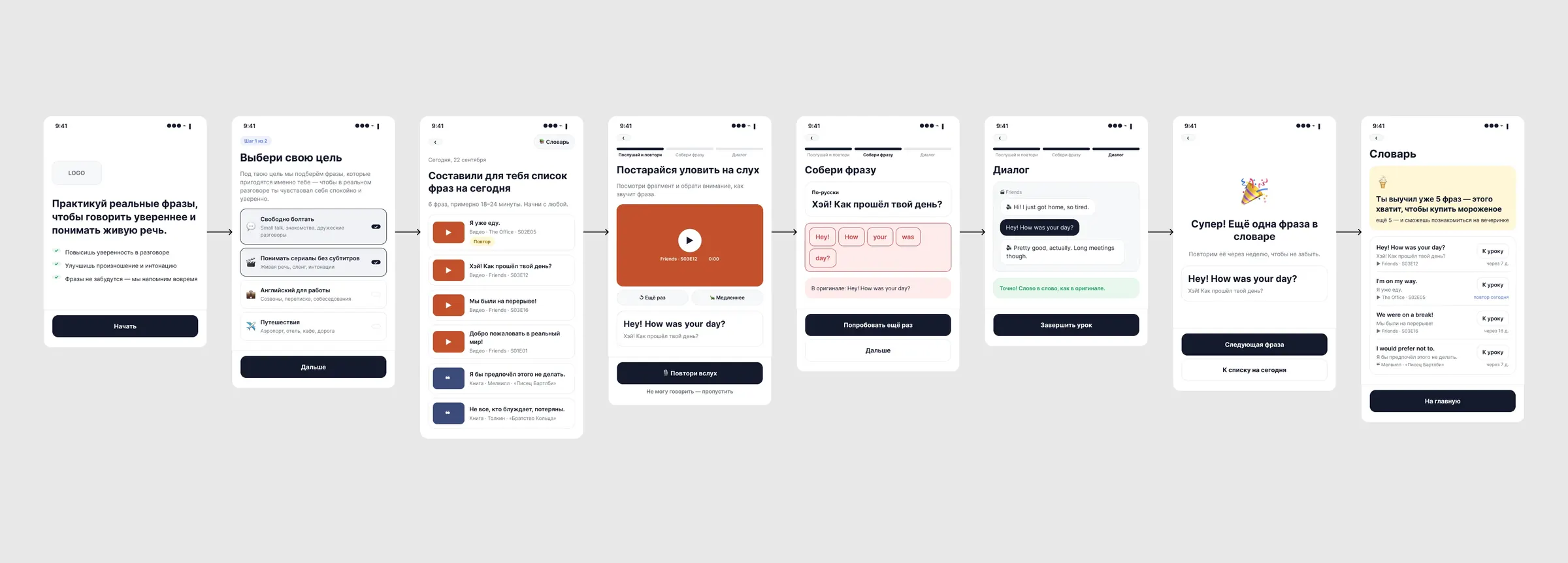
How the flow works
The first version includes only what the hypothesis can't be tested without.
- Intro with no sign-up, to get to the first phrase faster.
- Goal: small talk, TV shows, work, travel. It drives which phrases you get.
- Level: three options with plain descriptions instead of A1–C1, no placement test. At the confident level you type the phrase instead of building it from word tiles.
- Today's list: 5 new phrases and up to 3 reviews. Saying a phrase out loud is 3–4 times harder than learning a word, and a session should fit into 15–20 minutes.
- A three-step lesson: listen and repeat → build the phrase → dialogue.
- Review a week later: you say the phrase from memory, and it counts at 80% of the words.
Decisions
- 7 lesson steps → 3. Otherwise one phrase takes 10+ minutes and the daily goal can't be done. For example, I removed "fill in the missing word": that's recognition, while building the whole phrase is recall, which sticks better.
- A 20% threshold in the dialogue. The other person only asks again if they understood less than 20% of the words: nobody asks again over one word in real life.
- Reviews no sooner than a week later. Classic SRS reviews more often, but then the workload jumps from day to day. I care more about keeping it predictable. Whether that works still needs testing.
What testing showed
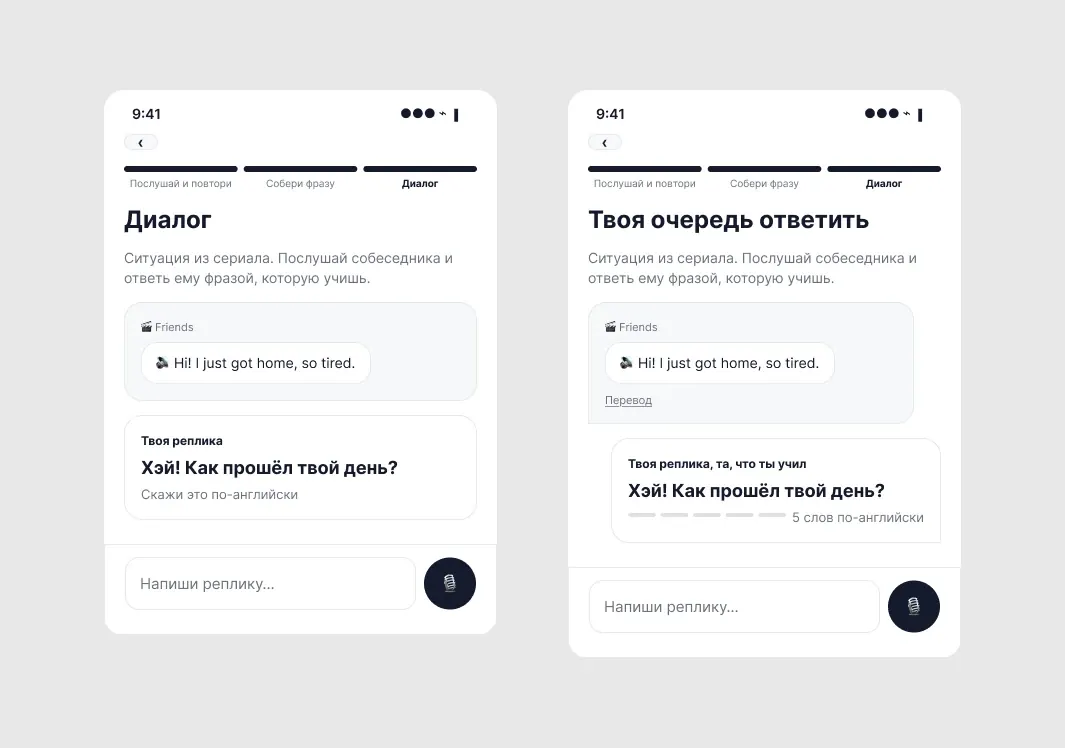
At the "Dialogue" step it wasn't clear that you should answer with the phrase you had just learned. The hint lived in a separate card under the chat and looked like a new task.
After the fix, the hint moved inside the chat. Now it's an empty bubble on the user's side labelled "your line", with the translation and a dash for each word. The heading became "Your turn to answer".
Prototype and content
The prototype behaves like a real app: it saves progress, listens through the microphone, plays only the part of the video with the phrase, and that part can be replayed or slowed down.
For the MVP I chose the official YouTube embed: clips only from official channels, and the video stays with its owner. Three AI agents fill the database: the first finds clips, the second builds a lesson from them, the third checks it. I check timings by ear myself, since auto-subtitles are off by 0.1–0.2 s.
What's next
Fill the database (10 phrases for each of the three levels), add the visual design and test with users. In the backlog: practice on specific mistakes, word-by-word breakdown of a line, an adjustable daily goal, accounts and sync, a product name.